

How Much Is Half A Crown In American Money
| U.k. | |
| Value | + ane⁄8 pound sterling |
|---|---|
| Mass | (1816–1970) 14.14 g |
| Bore | (1816–1970) 32.31 mm |
| Edge | Milled |
| Composition | (1816–1919) 92.5% Ag (1920–1946) 50% Ag (1947–1970) Cupronickel |
| Years of minting | 1707–1970 |
| Obverse | |
 | |
| Design | Profile of the monarch (Elizabeth Two design shown) |
| Designer | Mary Gillick |
| Design date | 1953 |
| Reverse | |
 | |
| Blueprint | Various (crowned Royal Shield shown) |
| Designer | Edgar Fuller and Cecil Thomas |
| Design date | 1967 |
The half crown was a denomination of British money, equivalent to two shillings and sixpence, or one-eighth of a pound. The half crown was kickoff issued in 1549, in the reign of Edward VI. No one-half crowns were issued in the reign of Mary, but from the reign of Elizabeth I half crowns were issued in every reign except Edward VIII, until the coins were discontinued in 1970.
The half crown was demonetised (ahead of other pre-decimal coins) on ane Jan 1970, the year earlier the United kingdom adopted decimal currency on Decimal Twenty-four hour period. During the English Interregnum of 1649–1660, a republican half crown was issued, bearing the arms of the Republic of England, despite monarchist associations of the money'south proper noun. When Oliver Cromwell was made Lord Protector of England, one-half crowns were issued bearing his semi-royal portrait. The half crown did non display its value on the opposite until 1893.
History of the one-half crown by reign [edit]
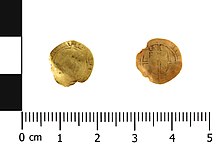
Gold half crown of Elizabeth I, 1580/81

This Charles I half crown was struck from a piece of hammered silver plate during one of the Ceremonious War sieges of Newark, Nottinghamshire.
- King Henry 8 1526: the first English one-half crown was struck in aureate.
- Male monarch Edward Six 1551: issued the start half crown in silver. The money was dated and showed the male monarch riding a horse.
- Queen Mary I: the half crown was struck on Mary's marriage to Philip II of Spain in 1554 simply was never issued for circulation. 3 specimens exist.
- Queen Elizabeth I: aureate half crowns were issued once more. At the end of the reign silver half crowns were issued.
- Male monarch James I: gilt half crowns were issued again. During the reign silvery half crowns were issued.
- King Charles I: silvery half crowns were issued, including those struck as obsidional money, money of necessity during the Civil State of war menses.
- Commonwealth of England: Oliver Cromwell silver half crowns were issued. During the years 1656 and 1658 milled half crowns were issued of Oliver Cromwell.
- Rex Charles Ii 1663–1685: argent half crowns were issued, and this menstruation saw the end of the hammered consequence of half crowns.
- King James II 1685–1688: silver half crown.
- Male monarch William III & Queen Mary II 1689–1694: silver one-half crown.
- William 3 of England 1694–1702: silver half crown.
- Queen Anne 1702–1714: silver one-half crown.
- Rex George I 1714–1727: silver one-half crown.
- Male monarch George II 1727–1760: silvery half crown.
- King George III 1760–1820: argent half crown.
- Male monarch George 4 1820–1830: silver half crown.
- King William IV 1830–1837: silver half crown.
- Queen Victoria 1837–1901: silver one-half crown.
- King Edward Seven 1902–1910: silver half crown.
- King George V 1910–1936: silver half crown, sterling silver (92½% silver) until 1919, then 50% silver.
- King Edward Eight 1936: 50% silvery one-half crown. Not issued for circulation.
- King George VI 1937–1952: 50% silver one-half crowns were issued until 1946 when the metal was changed to cupro-nickel.
- Queen Elizabeth Ii 1953–1967: the last one-half crown for general apportionment was issued in 1967, and the coin was withdrawn in 1970, before decimalisation. Proof sets of £sd coins, including the halfcrown, were issued by the Royal Mint, begetting the date 1970.
Size and weight [edit]
From 1816, in the reign of George Iii, half crown coins had a bore of 32 mm and a weight of 14.14 grams (defined as v⁄11 troy ounce[i]), dimensions which remained the aforementioned for the half crown until decimalisation in 1971.[two]
Mintages [edit]
The mintage figures beneath are taken from the annual Britain publication COIN YEARBOOK.[3] Proof mintages are indicated in italics.
| Victoria | (Jubilee) | |||
| 1887 | ane,438,046 | 1890 | three,228,111 | |
| 1888 | 1,428,787 | 1891 | 2,284,632 | |
| 1889 | 4,811,954 | 1892 | i,710,946 | |
| Victoria | (Old Head) | |||
| 1893 | ane,792,600 | 1898 | 1,870,055 | |
| 1894 | one,524,960 | 1899 | ii,865,872 | |
| 1895 | 1,772,662 | 1900 | 4,479,128 | |
| 1896 | 2,148,505 | 1901 | 1,516,570 | |
| 1897 | 1,678,643 | |||
| Edward Seven | ||||
| 1902 | 1,316,008 | 1907 | 3,693,930 | |
| 1903 | 274,840 | 1908 | i,758,889 | |
| 1904 | 709,652 | 1909 | 3,051,592 | |
| 1905 | 166,008 | 1910 | 2,557,685 | |
| 1906 | 2,886,206 | |||
| George V | ||||
| 1911 | 2,914,573 | 1924 | 5,866,294 | |
| 1912 | four,700,789 | 1925 | 1,413,461 | |
| 1913 | 4,090,169 | 1926 | 4,473,516 | |
| 1914 | 18,333,003 | 1927 | six,837,872 | |
| 1915 | 32,433,066 | 1928 | 18,762,727 | |
| 1916 | 29,530,020 | 1929 | 17,632,636 | |
| 1917 | eleven,172,052 | 1930 | 809,051 | |
| 1918 | 29,079,592 | 1931 | 11,264,468 | |
| 1919 | ten,266,737 | 1932 | 4,793,643 | |
| 1920 | 17,982,077 | 1933 | 10,311,494 | |
| 1921 | 23,677,889 | 1934 | 2,422,399 | |
| 1922 | xvi,396,724 | 1935 | 7,022,216 | |
| 1923 | 26,308,526 | 1936 | 7,039,423 | |
| George VI | ||||
| 1937 | ix,106,440 | 1945 | nineteen,849,242 | |
| 1938 | 6,426,478 | 1946 | 22,724,873 | |
| 1939 | 15,478,635 | 1947 | 21,911,484 | |
| 1940 | 17,948,439 | 1948 | 71,164,703 | |
| 1941 | 15,773,984 | 1949 | 28,272,512 | |
| 1942 | 31,220,090 | 1950 | 28,335,500 | |
| 1943 | fifteen,462,875 | 1951 | 9,003,520 | |
| 1944 | 15,255,165 | 1952 | 1[iv] | |
| Elizabeth Ii | ||||
| 1953 | 4,333,214 | 1961 | 25,887,897 | |
| 1954 | 11,614,953 | 1962 | 24,013,312 | |
| 1955 | 23,628,726 | 1963 | 17,625,200 | |
| 1956 | 33,934,909 | 1964 | 5,973,600 | |
| 1957 | 34,200,563 | 1965 | 9,778,440 | |
| 1958 | 15,745,668 | 1966 | thirteen,375,200 | |
| 1959 | 9,028,844 | 1967 | 33,058,400 | |
| 1960 | nineteen,929,191 | 1970 | 750,000 |
Gallery [edit]
-

Edward Half-dozen half-crown, 1552
-

Gold half crown of James I
-

Charles I one-half-crown
-

Half crown of Charles Two, 1680
-

Half crown of James II, 1687
-
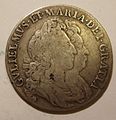
One-half crown of 1691: William 3 and Mary 2
-
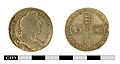
Half crown of William III, 1696
-
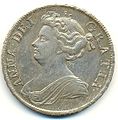
Half crown of Queen Anne
-

Half crown of George II, 1746
-

Half crown of George III, 1816
-

Half crown of George 4, 1821
-

One-half crown of William 4, 1836
-

Half-crown of Victoria, 1885
-

One-half-crown of Victoria, 1888
-

The reverse of the 1905, Edward VII, half crown
-

George V half crown, 1930
-

George VI one-half crown, 1948
-

The obverse of the 1953, Elizabeth 2, half crown
-

The reverse of the 1953, Elizabeth II, half crown
See besides [edit]
- Half crown (Irish money)
References [edit]
- ^ Kindleberger, Charles P. (2005). A Financial History of Western Europe. Taylor & Francis. p. 60. ISBN9780415378673.
- ^ Tony Clayton. "Coins of the Great britain - 30 Pence". coins-of-the-great britain.co.uk.
- ^ "Coin, Banknote and Medal Collector's Magazines. Token Publishing Numismatic Interest". tokenpublishing.com.
- ^ "Welcome to Colin Cooke Coins - Numismatics, Coins, Rarities - 1952 Halfcrown". colincooke.com.
External links [edit]
- [one] - View coins from the Democracy of England period, 1649–1660, including halfcrowns.
- British Coins - Free data about British coins (from 1656 to 1952). Includes an online forum.
- Coins of the Great britain - A full history of the half crown.
- The History of the One-half-crown
- Halfcrown, Coin Blazon from United Kingdom - Online Money Club
Source: https://en.wikipedia.org/wiki/Half_crown_%28British_coin%29
Posted by: moffettciew1936.blogspot.com
0 Response to "How Much Is Half A Crown In American Money"
Post a Comment