

How Much Money Is In The Clinton Foundation?
Charities tied to the Clinton family take received seemingly countless scrutiny throughout the presidential campaign. They've been accused of wasting funds, offer access to donors and even serving as a personal "piggy bank" for the Clinton family unit. As a result, the largest arm of their charitable organisation this calendar week said it would go an independent organization if Hillary Clinton is elected president.
The scrutiny of the Clintons' charities has extended to Trump's much smaller foundation also, including a just-announced investigation by the New York attorney general and a series by The Washington Post.
As a researcher focused on nonprofit finances, I am not accustomed to seeing such widespread interest in the sources and uses of funds past charities. Even if often wrapped up in political rancor, the public interest in the Clinton family's charities provides an opportunity to look closely at what they really are, what they do and how their coin is used.
While the inner workings of the organization are left to insiders, we fortunately have admission to public financial disclosures that help provide answers to these questions. As nosotros will see, the answers reveal an interesting and complex organization that may warrant critique just also deserves credit for its appetite and innovation.
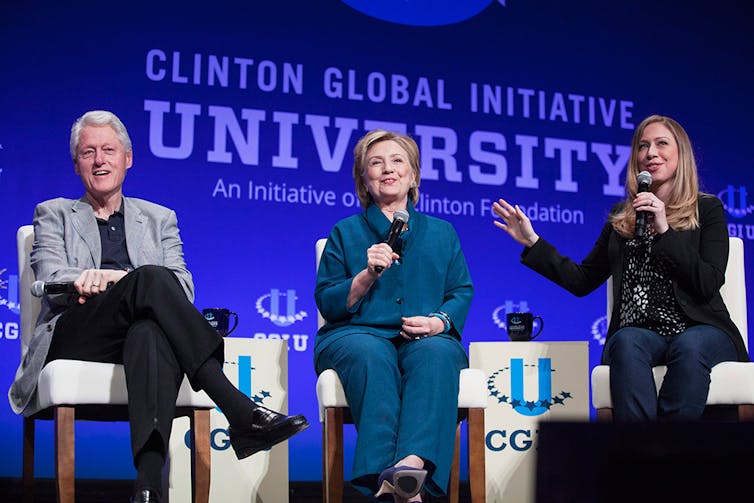
What are the Clinton charities?
We start with what organizations make upwards the network of Clinton charities.
Beginning up is the Clinton Family unit Foundation, which was gear up in 2001 as a private foundation to direct the family'south own personal giving but doesn't engage in whatever charitable activities of its own.
Information technology acts similar any other individual foundation in that the family unit makes donations to it, and the organization (over time) disburses funds to operating public charities.
From 2010 to 2014, the Clintons gave US$10.2 million of their income to the Family Foundation, which disbursed $nine.viii million to charities over the same period. Of that, $2.86 million (29 percent) went to initiatives tied to the Bill, Hillary & Chelsea Clinton Foundation, the main operating public charity they founded in 1998. The remaining $6.96 meg went to a variety of charities, both local and national, aimed at varied causes ranging from education to health intendance to the environment.
The Nib, Hillary & Chelsea Clinton Foundation is substantially the "parent" organization of diverse initiatives and offshoots, a few of which have been (at times) legally distinct from still remain controlled by the parent. This group of organizations, which includes the Clinton Global Initiative (CGI), Clinton Health Access Initiative (CHAI) and the Clinton Giustra Enterprise Partnership (CGEP), is collectively chosen "The Clinton Foundation."
The many different initiatives reflects the broad and oft shifting goals of the organization, which we hash out next.
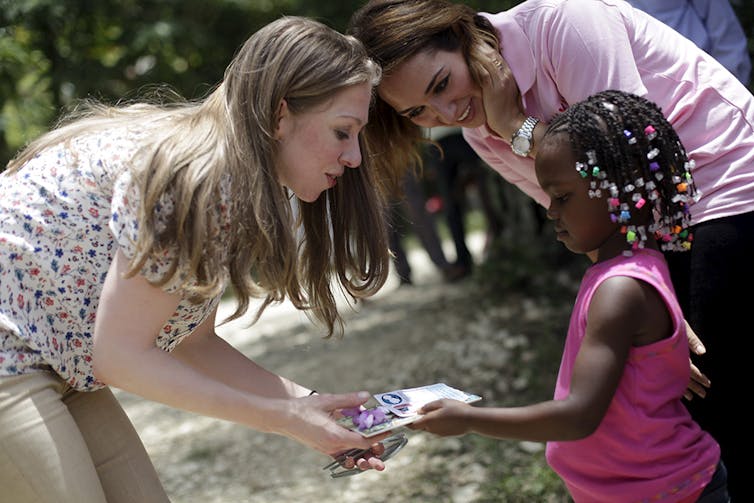
And then what does the Clinton Foundation exercise?
The activities of the Clinton Foundation are a source of many misconceptions, which is understandable given the broad range of them.
For starters, it's of import to stress that the Clinton Foundation (unlike the Family Foundation) is an operating public charity, which means (1) it relies heavily on donations from the general public, and (2) it does not primarily deed to disburse funds to other charities simply rather engages in direct "on-the-footing" services.
The starting time point is noteworthy because the Clintons' personal giving of about $2.86 million to the foundation accounted for just 0.four percent of its $807 million in contributions from 2010 to 2014.
Other funders include individuals (Gateway cofounder Theodore West. Waitt and former Formula Ane champion Michael Schumacher), foundations (Gates and Rockefeller), businesses (Coca-Cola and Barclays) and even foreign governments (Kingdom of norway, Australia and Saudi arabia).

It's also of import because soliciting donations from so many other individuals and entities – some of whom had personal connections with the Clintons or involvement in Country Department concern – is what has fueled many criticisms levied at the organisation.
The 2d point matters because some rival politicians take used the depression per centum of donations or grants that it gives to other charities as bear witness it spends little on charitable works. In this example, however, the lion's share of the organisation'southward programme spending is for on-the-ground efforts. Inquiry I conducted with a colleague demonstrates that this can really be an indicator of greater effectiveness than grants lone.
Some of the foundation'south most notable activities – and where much of its coin is spent – are run by the three organizations I mentioned before.
The Clinton Wellness Access Initiative has long been the largest of the arrangement'south initiatives and is now run equally a divide legal entity. While the foundation currently retains command by appointing a bulk of the board, the charity vowed on Sept. xiv to end this link and separate CHAI completely if Clinton wins in November.
CHAI has worked to secure discounted pharmaceuticals and other supplies for distribution, equally well equally increase opportunities for health care in over seventy countries, including India, South Africa, Vietnam and Zimbabwe.
The Clinton Global Initiative represents both the most innovative and most controversial programme of the organisation. CGI serves to match individuals and organizations willing to invest in projects aimed toward key public goals with charities and businesses seeking funding for their enterprises. Examples include funding loans to disabled veteran entrepreneurs and providing money for clinics in small villages in Red china.
In a sense, CGI serves a part similar to Uber'due south in providing a platform to facilitate a mutually beneficial match. In this case, the match is aimed at securing funds to achieve social goals. Like Uber, the approach has the potential to advance activity (equally evidenced by hundreds of millions of dollars in CGI commitments in 2015 alone). As well like Uber, the organization has faced the claiming of vetting the parties it matches (as evidenced by concerns about funding being secured for a for-profit enterprise run by friends of the Clintons).
Clinton Giustra Enterprise Partnership also brings both praise and criticism for its unique approach. With funding from Canadian billionaire Frank Giustra and partnerships with Mexican billionaire Carlos Slim, CGEP represents a hybrid model that provides capital to enterprises, many of which are for-profit, that seek to achieve Clinton Foundation goals.
Blurring the boundaries betwixt for-profit and nonprofit activities, CGEP is ahead of the bend in seeking new ways to reach social good (the Chan Zuckerberg Initiative is another notable newcomer to this loonshit). Yet, its approach, both in terms of its funding sources and its funding uses, also subjects the organisation to criticism.
The Clinton Foundation'southward other on-the-ground efforts run the gamut from helping schools develop and deliver healthy food choices (Alliance for a Healthier Generation) and providing farming and economic assistance in underdeveloped countries (Clinton Development Initiative) to supporting the Clinton Presidential Center in Arkansas.
Along with CHAI, many of the foundation's other initiatives will likely be spun off or eliminated if Clinton is elected president.
How does the Clinton Foundation spend its money?
The last area of common misunderstanding is how the organization'south funds are spent.
To address this question best, the place to go is their audited financial statements, which consolidate the activities of all the entities that make up the Clinton Foundation.
Every bit a point of context, consider the system's size. In 2014, the Clinton Foundation had expenses of $250 million, which puts it smaller than its venerable peer the Carter Middle at $332 million only much larger than the Donald J. Trump Foundation, which spent $597,000 in its most recent year.
Equally for where those funds went, the first thing to note is what it doesn't spend a lot of coin on: overhead. In its most recent audited financials, the Clinton Foundation reported spending 87.ii percent on programs and services, which ways 12.8 percent is going to "overhead" – administrative and fundraising costs. While not the ultimate arbiter of effectiveness, such a figure is well above the 65 percent to 75 percent range of program spending often suggested as a dominion-of-thumb.
The Clinton Health Admission Initiative alone accounts for well-nigh 2-thirds of all program spending, or $143 million. That's perhaps no surprise given global wellness has been a longstanding focus of the organization. The rest goes to the Global Initiative (11 percentage), the Giustra Enterprise Partnership (three percentage) and a variety of other projects.
This tells u.s.a. where the money goes in terms of the split among different goals, but another key question is what is the coin used for specifically. While some may recollect that on-the-ground activities means supplies and cash assistance, charitable organizations besides spend much of their coin on labor, meetings and travel. The Clinton Foundation is no exception, with labor, meetings and travel accounting for 37 per centum, 12 percent and 8 percent of program spending, respectively.
Evaluating a charity
And so where does this leave u.s.?
Conspicuously the Clinton Foundation is a complex organization that does a wide multifariousness of charitable activities, is funded by many individuals and organizations and spends the majority of its money on the programs and initiatives that meet its goals. That said, its choices over where to spend money on the ground are open to criticism over whether donor resources are being used to their all-time potential. It's a difficult question that financial statements aren't detailed enough to provide (and is really something that all charities grapple with internally).
Withal, being focused on developing relationships with funders and partner governments, offering on-the-ground grooming and assistance and convening meetings of funding providers advise labor, travel, and meeting costs should be primal components of any charity. And in that regard, the Clinton Foundation'south spending looks like you may expect it to given its methods and goals.
These are all things worth bearing in mind the next time you read a headline about the Clinton Foundation.
Source: https://theconversation.com/what-do-the-clinton-charities-actually-do-and-where-does-their-money-go-65287
Posted by: moffettciew1936.blogspot.com
0 Response to "How Much Money Is In The Clinton Foundation?"
Post a Comment