

What is Device Security in Windows 11/0 and how to hide this area?
Windows Defender has at present been integrated withWindows Security and it includes a Device Security section in Windows eleven/ten, which is meant to give you improve insights into the security features integrated with your Windows device. In this post, we volition explain what is Device Security in Windows xi/10 and how you tin disable or hide it, should you wish to.
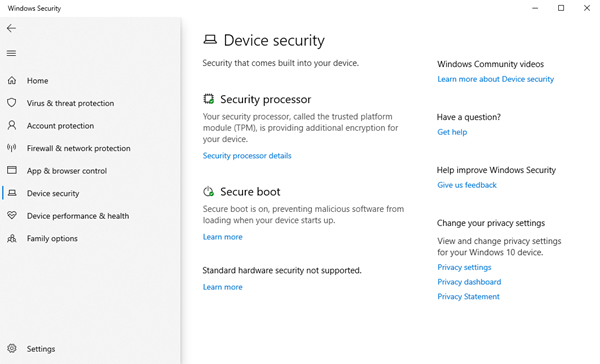
Device Security in Windows xi/10
The 'Device Security' protection area in Windows 11/10, is one of the seven areas that protect your device and let you specify how you lot desire your device protected in Windows Security Eye.
The seven areas include-
- Virus & threat protection
- Business relationship protection
- Firewall & network protection
- App & browser control
- Device security
- Device functioning & health
- Family options.
Generally, Device Security gives you lot greater insight into the security features integrated into your Windows device. The page provides you with status reporting and management of security features built into your devices – including toggling features on to provide enhanced protections.
What you see in 'Device Security' will depend on the security features that come congenital into your device. On this panel, one of the following messages will exist seen, depending on your device'south arrangement configuration:
- Your device meets the requirements for standard hardware security
- Your device meets the requirements for enhanced hardware security
- Your device exceeds the requirements for enhanced hardware security
- Standard hardware security not supported.
Typically, the features available are-
- Core isolation provides added protection confronting malware and other attacks by isolating estimator processes from your operating system and device. You tin can enable, disable, and alter the settings for core isolation features here.
- Memory integrity can help forestall malicious code from accessing high-security processes in the effect of an attack.
- Secure boot prevents rootkit-like sophisticated malware from infecting your system during boot.
- Security processor provides additional encryption features.
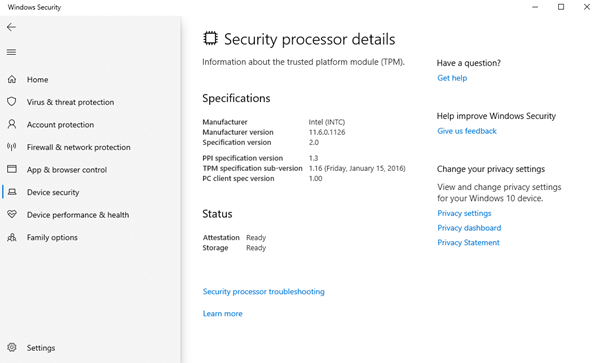
This is where you'll also run across whatsoever relevant fault messages about your security processor:
- Device health attestation isn't supported on this device.
- TPM storage is not bachelor. Delight clear your TPM.
- TPM measured boot log is missing. Effort restarting your device.
- There is a problem with your TPM. Try restarting your device.
- A firmware update is needed for your security processor (TPM).
- TPM is disabled and requires attention.
- Your TPM isn't compatible with your firmware, and may non be working properly.
- Device health attestation isn't available. Delight clear your TPM.
This expanse can be hidden from users. This tin can exist useful if, equally an admin, you don't want them to meet or have admission to this area. If you choose to hide the Account protection area, information technology will no longer announced on the home page of the Windows Security Center, and its icon volition not be shown on the navigation bar on the side of the app.
Messages you may see in Device Security
Your device meets the requirements for standard hardware security
This means your device supports memory integrity and core isolation and also has:
- TPM 2.0 (also referred to every bit your security processor)
- Secure boot enabled
- DEP
- UEFI MAT
Your device meets the requirements for enhanced hardware security
This means that in addition to meeting all the requirements of standard hardware security, your device also has memory integrity turned on.
Your device has all Secured-cadre PC features enabled
This means that in addition to coming together all the requirements of enhanced hardware security, your device also has Organisation Management Manner (SMM) protection turned on.
Standard hardware security non supported
This means that your device does not come across at least one of the requirements of standard hardware security.
How to Show or Hide Device Security
Evidence or Hibernate Device Security via GPEDIT
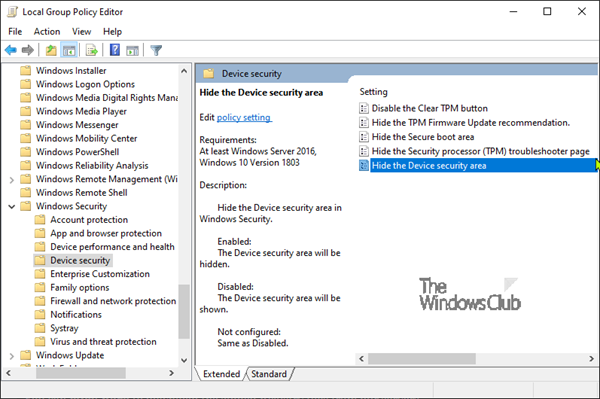
- Rungpedit to open up the Group Policy Editor
- Navigate toComputer Configuration >Authoritative templates >Windows components >Windows Security > Device Security.
- Open theHibernate the Device security area setting
- Set information technology toEnabled.
- ClickOK.
Hide Device Security via Registry
- Double-click the downloadedHide-Device-Security.reg file to merge information technology.
- ClickRun on the prompt. ClickYes on UAC prompt andOK to allow the merge.
- Restart PC to utilise.
- Yous tin can now delete the downloaded .reg file.
Show Device Security via Registry
- Double-click the downloadedBear witness-Device-Security.reg file to merge it.
- ClickRun on the prompt. ClickYep on UAC prompt, andOK to let the merge.
- Restart PC to utilise.
- Y'all can now delete the downloaded .reg file.
You canclick here to download the zipped Registry files from our servers.


Source: https://www.thewindowsclub.com/what-is-device-security-in-windows-10
Posted by: moffettciew1936.blogspot.com
0 Response to "What is Device Security in Windows 11/0 and how to hide this area?"
Post a Comment